Friday, October 23, 2026


A Thin Time

The Ancient Celts knew that the end of October and beginning of November as the “thin time of the year,” also known as Samhain (SAH-win).  It’s when the veil of the living and the departed is thin and if we call to an ancestor, they just might visit us. 

What got me thinking about this today was something I experienced as I came down our stairs this morning.  As I approached the landing midway and began to make the next few steps down, the vestibule door suddenly opened.  The outside front door was closed and locked.  There wasn’t any breeze blowing in any direction, nor was the furnace on.  These could offer a reason for the door to swing open.  It’s an old house that we live in, and the doors are sturdy and thick.  For this one to just suddenly open seemed, not unusual, but rare.  There has been, on occasion, the sudden opening of a door in the house, including this door, which immediately took my attention. Having 50 percent Celtic DNA, and a bit of mystic curiosity, I’m convinced these thin moments are nearer to us than we realize.  Could this be one of those moments? 

I hesitated on the stairs, and peered at the half open door. I called “Hello?” Like maybe someone would answer, though no one was standing there but me.

I continued down the stairs and over to the door and closed it.  I wondered which of the ancestors might be visiting.   I thought about the people that used to live in the house when it was first built in 1913.  It is an American Foursquare built on farm land.  The sconces on the walls would have used gas for light.  There would have been an icebox, not a large refrigerator.  But then, they have been coming to visit for over a hundred years now.  They see the changes in how we live and how society has changed.  They would have lived through World War I.  They would have struggled over immigration and corrupt politics.  I wonder if when they pass through this thin time they reminisce about the “good old days,” or if they think things really haven’t changed in that respect.

Maybe someday, after I’ve departed, I’ll come back and open the door to the hallway and pass through the vestibule, wandering around the rooms, observing how things have or have not changed.  Will I be thinking of the “good old days?”  Maybe someone will be coming down the stairs and will stop and look and wonder how that door opened.  Will they think, ‘which ancestor is this’?  Or maybe they’ll just close the door and go make coffee.


Thursday, February 10, 2022

The Love Story of Twink & Spike: A Valentine for All Ages


This is the love story of Twink and Spike --


Last summer we trapped, neutered, and released many cats. Spike, and his brother Archie were two of our favorite black n whites. When they came back to us, they were less trusting, as you can imagine. Spike would visit now and then, but Archie never came back and we feared that something dire had happened to him. Some months passed, and a new little creature appeared at our back door. It was a rather pitiful little gray cat, rather demure in nature, and little white paws. Peg called her Twinkle Toes. She did not seem feral but rather abandoned. (Spike and Archie were from a feral mother.)


We managed to trap Twink (I shortened her name) and she was neutered and released again to us. The weather was warm and she would sleep in my rocker chair on the back porch. Eventually Spike wandered back and seemed to take a shine to Twink. And Twink, I think… was quite enamored with Spike. At one point we think she either followed him, or he took her over to meet the neighborhood colony on Seneca Parkway. There’s a hole in the fence out back where they have a sure path that connects our house with the one out back.


 I was glad when Twink decided to stick to our back porch as I didn’t want her learning the “street-ways” of the tougher ferals. We made a shelter as winter was approaching and put it under the deck. We also bought a heated “cat tent” for the back porch that seemed just her size. As the weather got colder other critters came to the back porch to finish the food in her dishes – a raccoon the size of a small dog, a little possum, and one or two stray ferals from outside the colony.


Twink would crawl into her tent house protected from the wild life and weather outside. As time passed, one or two of the stranger ferals tried to take over Twink’s space. But
Spike came to her rescue. He would sit on the deck when she was eating supper
and watch for the others – kept them away. He was seen sitting on top of her
tent shelter keeping others out.


I went out one morning to feed Twink and both she and Spike crawled out of the little tent house. It was obvious now that they had become an “item.”


I share these photos, and this journey of Twink and Spike with you for your pleasure and wish you all a Happy Valentine Season!

More photos of Twink & Spike making a life together --

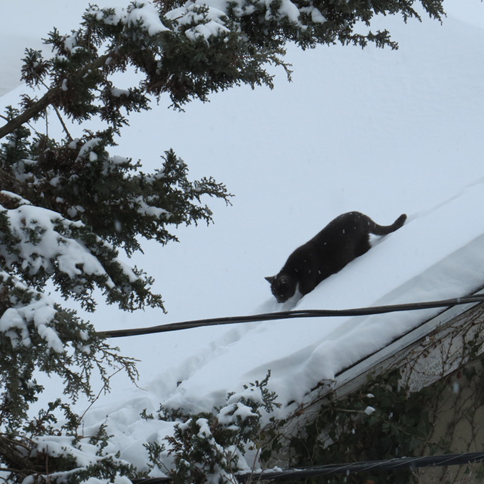
                   Twink learns how to get through the heavy snow --


Spike keeps an eye on Twink --


Twink & Spike: A Love Story 2/2022


Monday, April 20, 2020

The Anchorite’s Milk Box


Some years back when I was studying theology, I did a paper on Julian of Norwich.  She left her life as a married woman and mother to become an anchorite or spiritual recluse and devoted her life to God.  She went to live in a small room off the Church of Norwich which for monks and abbots is called a cell.  There she had no luxuries and spent most of her time talking to God.  There was a small window at the edge of her cell that looked out to a court yard where people would pass by, some stopping to ask Julian for prayer.

An epidemic of plague overtook Europe and people in Julian’s hometown were frightened.  They were convinced that this illness was sent by God to punish them for their sins.  It was at that time Julian heard God say, “ All shall be well – All manner of things shall be well”.

This context crossed my mind as I struggled to find liquid soap during the current Covid19 pandemic.  Being in the high-risk category of people who should not venture out into public places, I was dependent on others to do grocery shopping for me. Due to the sins of greedy people, Items such as disinfectants, paper towels, toilet paper, and liquid soap were not easily available.

I was speaking with my neighbor about this and she informed me that she had lots of liquid soap on hand and I should bring my empty container over and she would fill it.  She instructed me to come to her milk box on the side of her house to get my refill.  I donned my face mask and walked across the street.  There, waiting on the inside of the opened box, was the anchorite ready to answer my prayer for liquid soap. 

We chatted about the state of the world while she filled the container.  When done, we promised to get together again, open-faced like happy sandwiches, relieved and free from harm’s way.

I thanked my neighbor, and walked back home.  I thought about Julian in her stone cell looking out the window, and wondered how life would be without liquid soap.

Sunday, February 16, 2020

Choosing Hate or Choosing Kindness


When I first read this headline, I thought to myself, “Well now this kid has been kicked out of college and will hang around with other racist, homophobic or bigoted people like himself and will never learn tolerance, understanding or how to control himself in pubic.”  Somehow, I don’t think the punishment fit the crime.  It’s not disciplinary unless we seek to reverse a negative action into a positive change.

Then I got to thinking, this is a perfect example of where our current society has migrated—hateful actions will bring about other hateful actions.  This is the type of situation where a young man who might have had an opportunity to educate himself, had a reasonable and just discipline for his actions, will now – quite possibly—find a weapon and lash out on unsuspecting bystanders. 

I really hate what we’ve all become.  And I use the word “we” sparingly, and include myself because there are times I am so despondent and so fed-up with political acts of revenge and exclusion, that I just want to rip someone’s head off.  But, of course, I don’t.  Instead I put myself in this myopic space looking only for “the good” until “the bad” feeling passes.

From the “Pause,” journalist Ezra Klein talks with Krista Tippett about “Why we are so polarized?”  He says, “We need to build a politics where one of our aims is the participation and respect, we give to each other. That doesn’t mean a politics where the fights aren’t hard-fought or the stakes aren’t high or everything is compromised down for no reason … but we need to be looking to pull people into the process, and we need to be looking to pull people back from the ledge.” 


Comments welcome --

Thursday, November 7, 2019

Surviving the State of the Body Politic


                                              The Survivor's Boat and the Dinghies 

I’ve been vague this year about my opinions, sitting back and letting the world zip by in its own drowning chaos.  Being older and retired has given me a sense of doldrums and a kind of fatalism that it doesn’t really matter what I think about the state of the body politic.  We’re going to hell in a handbasket and nothing I do or say will make much difference.  The problem with that state of mind is that too many of us are in that state of mind.  So, the bully pundits and small-minded bureaucrats continue to make terrible decision based on their purported facts and self-interests thus accelerating our demise.


That sucks.


What I’d like to see is a collapse of the governmental parties that run our nation.  Why do we need to compartmentalize as a people?  Does it really matter if more Republicans win in an election then Democrats? Shouldn’t people of any party have everyone’s welfare at heart?  I recently watched the video on Reconstruction when the Republican party was the good guys and the Democrats were the bad guys—depending on what side of the Mason Dixon line you were on and your opinion of slavery and state’s rights.  


And what about all the other parties that want to represent we people of these United States?  The Conservatives, the Liberals, the Working Party, the Socialist Democrats, the Green Party—and probably there’s more parties than I know.  I’m guessing that humans have divided themselves into separate groups from the time of creation.  Maybe those first few groups banded together for survival, but as they got larger and stronger and wiser and more capable of surviving on their own, they split apart.  Perhaps it was for the survival of the fittest.  That meant that some would be left behind.

Here we are now, all these years later, and it is amazing how humanity has kept that kernel of separatism—someone always being better than someone else.  Maybe we can’t all live together in peace.  Maybe it’s just not feasible.  But at heart, I’m an optimist.  I do believe that for our survival we will find a way through the muck. In my mind’s eye I see all the divisive bullies in small dinghy’s being towed behind the larger ships as those of us who survive the change of climate sail off to find a new land—voting for a small group of people who will serve the majority and not call themselves Congress.

Saturday, January 26, 2019

What I Did When I Turned 70


                                                            Painting by Pamela Schiermeyer
For most of you reading this I’m guessing you are way under 70 years old.  In fact, when thinking about this number in years, I thought, “Wow!  I wonder what it’s it like to be 70?”   

Generally speaking, age is a matter of relevance. If you don’t feel your age, its not relevant! Or is it?  This begs the question of how it feels to be any particular age.  How did it feel to be one or two years old?  That’s silly, right?  No one thinks about it at that age.

How did it feel to be sixteen or eighteen or twenty-one?  Those were pretty special ages and significant in what we perceived would happen in our lives at that time.  And one would have to factor in what was going on around us at that time.  Was it happy or a sad, good or bad?

Why do we even think or feel a certain way about age?  I’m guessing that as civilizations emerged people began to put emphasis on their age.  Sometimes it didn’t even matter about one’s intellectual or physical capabilities.  Young kids were put to work.  Old people were set aside and sometimes even left behind.  Well, I seem to be getting a bit too serious.

I’ve talked to some really old folks, like in their 80’s and 90’s and asked “What was your favorite decade.”  Most of them answered “This one!”  But then they were all rather healthy and mobile.  I was also told that by the time you’ve reached 70 most any horrible thing that will happen in life has happened.  That in itself seemed subjective, but that’s what they said.

So, given the comments and adjectives I got for reaching my 70th birthday—which I’ve been told is actually my 8th decade and totally blew my mind—I decided to get a tattoo.  My kids have always wanted me to get one.  We were supposed to all get a tribal symbol that would link our family.  That didn’t happen, so based on the fact I have had a spirit animal guide since I was 10, (and that’s another story for another time,) I decided to get a tattoo of a sea turtle on my right forearm.

I did some research and creative drawing and came up with a small figure and took it to a professional tattoo artist.  We set up a date on my birthday.  He took my drawing and worked it up a bit and I approved.

I won’t go into details, as most of you probably have had a tattoo, or have seen one done.  It took about an hour.  Maybe it’s because my skin is grandma aged, or maybe it’s because my forearm is more tender than other places, but I will tell you, it hurt like hell!  I don’t think giving birth was that bad.  But maybe.

At one point a very tall and husky bald man dressed in black leather came over to check things out. He had tattoos everywhere—running up his shoulder, his neck, and to the top of his head. 

He asked, “How ya’ doing?” 

I told him it was a bit more painful than I thought it would be.  Then I asked him, “How did it feel to get your head tattooed?”

He said he couldn’t remember, which I thought to myself, really IS a lot like childbirth. 
Raise your hand if you've got a tattoo ---

Wednesday, July 25, 2018

Do you dawdle or do you linger?


When I was about seven years old, I remember sitting at the kitchen table in the morning, eating oatmeal. It was a school day, and I do believe I was dawdling.  My grandmother spoke sternly, 

“Hurry up.  You’re going to be late.”

I was raised by my grandparents and most likely they had little patience for a youngster who was challenging, somewhat lazy, and stubborn.  I continued to dawdle.  
Grandma had a wooden paddle that hung on the wall next to the pencil sharpener behind the kitchen door.  It had a few cracks in it, and I can assure you, I was never hit with it.  There were only moments of threats that often worked with intended purpose.  However, that morning I remained steadfast in my dawdling until the paddle came off the hook, and slammed down  about 2 inches from my elbow which was leaning on the kitchen table.  A more emphatic stern voice repeated, 
“Hurry up!  You’re going to be late!”  
At that point my dawdling stopped. I quickly finished my breakfast and hightailed out of the house and off to school.  
This memory leads me to think that if I could have made the argument I was not dawdling but merely lingering, perhaps to savor the wonderful oatmeal my grandmother had made for me—you know, the kind with brown sugar and warm milk—I might have avoided the dreaded paddle threat.  But I was not clever at age seven.  And in fact, under the circumstances, I was rather dutiful.
This dawdling versus lingering seems a conundrum to me.  Physically, both are exhibited in the same way— “to move slowly and idly,” or “to spend a long time over something.”  I’m guessing it’s the intent behind the action that defines which word best describes what I was doing that morning before school.  And it does seem that dawdling has a more negative connotation than lingering.  
The older I get, the more I seem to dawdle AND to linger.  In some cases, it’s either my knees or my memory that causes me to dawdle.  And in other cases, it’s my sentimentality or perhaps my sense of spirituality that leads me to linger upon those things I find worthy and meaningful.  
Learning to dawdle and to linger is a lifetime achievement.  Most of us in our younger days were discouraged from such behavior, but now, if you happen to be in my generation of Baby Boomers, you might find advantages to dawdling and lingering.  After all, are we not now in charge of our own paddles?