Friday, October 23, 2026


A Thin Time

The Ancient Celts knew that the end of October and beginning of November as the “thin time of the year,” also known as Samhain (SAH-win).  It’s when the veil of the living and the departed is thin and if we call to an ancestor, they just might visit us. 

What got me thinking about this today was something I experienced as I came down our stairs this morning.  As I approached the landing midway and began to make the next few steps down, the vestibule door suddenly opened.  The outside front door was closed and locked.  There wasn’t any breeze blowing in any direction, nor was the furnace on.  These could offer a reason for the door to swing open.  It’s an old house that we live in, and the doors are sturdy and thick.  For this one to just suddenly open seemed, not unusual, but rare.  There has been, on occasion, the sudden opening of a door in the house, including this door, which immediately took my attention. Having 50 percent Celtic DNA, and a bit of mystic curiosity, I’m convinced these thin moments are nearer to us than we realize.  Could this be one of those moments? 

I hesitated on the stairs, and peered at the half open door. I called “Hello?” Like maybe someone would answer, though no one was standing there but me.

I continued down the stairs and over to the door and closed it.  I wondered which of the ancestors might be visiting.   I thought about the people that used to live in the house when it was first built in 1913.  It is an American Foursquare built on farm land.  The sconces on the walls would have used gas for light.  There would have been an icebox, not a large refrigerator.  But then, they have been coming to visit for over a hundred years now.  They see the changes in how we live and how society has changed.  They would have lived through World War I.  They would have struggled over immigration and corrupt politics.  I wonder if when they pass through this thin time they reminisce about the “good old days,” or if they think things really haven’t changed in that respect.

Maybe someday, after I’ve departed, I’ll come back and open the door to the hallway and pass through the vestibule, wandering around the rooms, observing how things have or have not changed.  Will I be thinking of the “good old days?”  Maybe someone will be coming down the stairs and will stop and look and wonder how that door opened.  Will they think, ‘which ancestor is this’?  Or maybe they’ll just close the door and go make coffee.


Thursday, February 10, 2022

The Love Story of Twink & Spike: A Valentine for All Ages


This is the love story of Twink and Spike --


Last summer we trapped, neutered, and released many cats. Spike, and his brother Archie were two of our favorite black n whites. When they came back to us, they were less trusting, as you can imagine. Spike would visit now and then, but Archie never came back and we feared that something dire had happened to him. Some months passed, and a new little creature appeared at our back door. It was a rather pitiful little gray cat, rather demure in nature, and little white paws. Peg called her Twinkle Toes. She did not seem feral but rather abandoned. (Spike and Archie were from a feral mother.)


We managed to trap Twink (I shortened her name) and she was neutered and released again to us. The weather was warm and she would sleep in my rocker chair on the back porch. Eventually Spike wandered back and seemed to take a shine to Twink. And Twink, I think… was quite enamored with Spike. At one point we think she either followed him, or he took her over to meet the neighborhood colony on Seneca Parkway. There’s a hole in the fence out back where they have a sure path that connects our house with the one out back.


 I was glad when Twink decided to stick to our back porch as I didn’t want her learning the “street-ways” of the tougher ferals. We made a shelter as winter was approaching and put it under the deck. We also bought a heated “cat tent” for the back porch that seemed just her size. As the weather got colder other critters came to the back porch to finish the food in her dishes – a raccoon the size of a small dog, a little possum, and one or two stray ferals from outside the colony.


Twink would crawl into her tent house protected from the wild life and weather outside. As time passed, one or two of the stranger ferals tried to take over Twink’s space. But
Spike came to her rescue. He would sit on the deck when she was eating supper
and watch for the others – kept them away. He was seen sitting on top of her
tent shelter keeping others out.


I went out one morning to feed Twink and both she and Spike crawled out of the little tent house. It was obvious now that they had become an “item.”


I share these photos, and this journey of Twink and Spike with you for your pleasure and wish you all a Happy Valentine Season!

More photos of Twink & Spike making a life together --

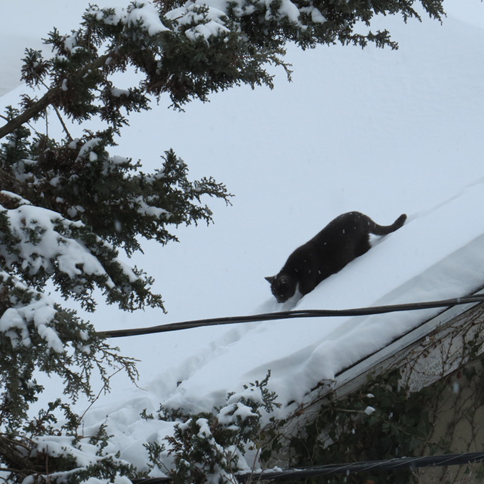
                   Twink learns how to get through the heavy snow --


Spike keeps an eye on Twink --


Twink & Spike: A Love Story 2/2022


Monday, April 20, 2020

The Anchorite’s Milk Box


Some years back when I was studying theology, I did a paper on Julian of Norwich.  She left her life as a married woman and mother to become an anchorite or spiritual recluse and devoted her life to God.  She went to live in a small room off the Church of Norwich which for monks and abbots is called a cell.  There she had no luxuries and spent most of her time talking to God.  There was a small window at the edge of her cell that looked out to a court yard where people would pass by, some stopping to ask Julian for prayer.

An epidemic of plague overtook Europe and people in Julian’s hometown were frightened.  They were convinced that this illness was sent by God to punish them for their sins.  It was at that time Julian heard God say, “ All shall be well – All manner of things shall be well”.

This context crossed my mind as I struggled to find liquid soap during the current Covid19 pandemic.  Being in the high-risk category of people who should not venture out into public places, I was dependent on others to do grocery shopping for me. Due to the sins of greedy people, Items such as disinfectants, paper towels, toilet paper, and liquid soap were not easily available.

I was speaking with my neighbor about this and she informed me that she had lots of liquid soap on hand and I should bring my empty container over and she would fill it.  She instructed me to come to her milk box on the side of her house to get my refill.  I donned my face mask and walked across the street.  There, waiting on the inside of the opened box, was the anchorite ready to answer my prayer for liquid soap. 

We chatted about the state of the world while she filled the container.  When done, we promised to get together again, open-faced like happy sandwiches, relieved and free from harm’s way.

I thanked my neighbor, and walked back home.  I thought about Julian in her stone cell looking out the window, and wondered how life would be without liquid soap.

Sunday, February 16, 2020

Choosing Hate or Choosing Kindness


When I first read this headline, I thought to myself, “Well now this kid has been kicked out of college and will hang around with other racist, homophobic or bigoted people like himself and will never learn tolerance, understanding or how to control himself in pubic.”  Somehow, I don’t think the punishment fit the crime.  It’s not disciplinary unless we seek to reverse a negative action into a positive change.

Then I got to thinking, this is a perfect example of where our current society has migrated—hateful actions will bring about other hateful actions.  This is the type of situation where a young man who might have had an opportunity to educate himself, had a reasonable and just discipline for his actions, will now – quite possibly—find a weapon and lash out on unsuspecting bystanders. 

I really hate what we’ve all become.  And I use the word “we” sparingly, and include myself because there are times I am so despondent and so fed-up with political acts of revenge and exclusion, that I just want to rip someone’s head off.  But, of course, I don’t.  Instead I put myself in this myopic space looking only for “the good” until “the bad” feeling passes.

From the “Pause,” journalist Ezra Klein talks with Krista Tippett about “Why we are so polarized?”  He says, “We need to build a politics where one of our aims is the participation and respect, we give to each other. That doesn’t mean a politics where the fights aren’t hard-fought or the stakes aren’t high or everything is compromised down for no reason … but we need to be looking to pull people into the process, and we need to be looking to pull people back from the ledge.” 


Comments welcome --

Thursday, November 7, 2019

Surviving the State of the Body Politic


                                              The Survivor's Boat and the Dinghies 

I’ve been vague this year about my opinions, sitting back and letting the world zip by in its own drowning chaos.  Being older and retired has given me a sense of doldrums and a kind of fatalism that it doesn’t really matter what I think about the state of the body politic.  We’re going to hell in a handbasket and nothing I do or say will make much difference.  The problem with that state of mind is that too many of us are in that state of mind.  So, the bully pundits and small-minded bureaucrats continue to make terrible decision based on their purported facts and self-interests thus accelerating our demise.


That sucks.


What I’d like to see is a collapse of the governmental parties that run our nation.  Why do we need to compartmentalize as a people?  Does it really matter if more Republicans win in an election then Democrats? Shouldn’t people of any party have everyone’s welfare at heart?  I recently watched the video on Reconstruction when the Republican party was the good guys and the Democrats were the bad guys—depending on what side of the Mason Dixon line you were on and your opinion of slavery and state’s rights.  


And what about all the other parties that want to represent we people of these United States?  The Conservatives, the Liberals, the Working Party, the Socialist Democrats, the Green Party—and probably there’s more parties than I know.  I’m guessing that humans have divided themselves into separate groups from the time of creation.  Maybe those first few groups banded together for survival, but as they got larger and stronger and wiser and more capable of surviving on their own, they split apart.  Perhaps it was for the survival of the fittest.  That meant that some would be left behind.

Here we are now, all these years later, and it is amazing how humanity has kept that kernel of separatism—someone always being better than someone else.  Maybe we can’t all live together in peace.  Maybe it’s just not feasible.  But at heart, I’m an optimist.  I do believe that for our survival we will find a way through the muck. In my mind’s eye I see all the divisive bullies in small dinghy’s being towed behind the larger ships as those of us who survive the change of climate sail off to find a new land—voting for a small group of people who will serve the majority and not call themselves Congress.

Saturday, January 26, 2019

What I Did When I Turned 70


                                                            Painting by Pamela Schiermeyer
For most of you reading this I’m guessing you are way under 70 years old.  In fact, when thinking about this number in years, I thought, “Wow!  I wonder what it’s it like to be 70?”   

Generally speaking, age is a matter of relevance. If you don’t feel your age, its not relevant! Or is it?  This begs the question of how it feels to be any particular age.  How did it feel to be one or two years old?  That’s silly, right?  No one thinks about it at that age.

How did it feel to be sixteen or eighteen or twenty-one?  Those were pretty special ages and significant in what we perceived would happen in our lives at that time.  And one would have to factor in what was going on around us at that time.  Was it happy or a sad, good or bad?

Why do we even think or feel a certain way about age?  I’m guessing that as civilizations emerged people began to put emphasis on their age.  Sometimes it didn’t even matter about one’s intellectual or physical capabilities.  Young kids were put to work.  Old people were set aside and sometimes even left behind.  Well, I seem to be getting a bit too serious.

I’ve talked to some really old folks, like in their 80’s and 90’s and asked “What was your favorite decade.”  Most of them answered “This one!”  But then they were all rather healthy and mobile.  I was also told that by the time you’ve reached 70 most any horrible thing that will happen in life has happened.  That in itself seemed subjective, but that’s what they said.

So, given the comments and adjectives I got for reaching my 70th birthday—which I’ve been told is actually my 8th decade and totally blew my mind—I decided to get a tattoo.  My kids have always wanted me to get one.  We were supposed to all get a tribal symbol that would link our family.  That didn’t happen, so based on the fact I have had a spirit animal guide since I was 10, (and that’s another story for another time,) I decided to get a tattoo of a sea turtle on my right forearm.

I did some research and creative drawing and came up with a small figure and took it to a professional tattoo artist.  We set up a date on my birthday.  He took my drawing and worked it up a bit and I approved.

I won’t go into details, as most of you probably have had a tattoo, or have seen one done.  It took about an hour.  Maybe it’s because my skin is grandma aged, or maybe it’s because my forearm is more tender than other places, but I will tell you, it hurt like hell!  I don’t think giving birth was that bad.  But maybe.

At one point a very tall and husky bald man dressed in black leather came over to check things out. He had tattoos everywhere—running up his shoulder, his neck, and to the top of his head. 

He asked, “How ya’ doing?” 

I told him it was a bit more painful than I thought it would be.  Then I asked him, “How did it feel to get your head tattooed?”

He said he couldn’t remember, which I thought to myself, really IS a lot like childbirth. 
Raise your hand if you've got a tattoo ---

Wednesday, July 25, 2018

Do you dawdle or do you linger?


When I was about seven years old, I remember sitting at the kitchen table in the morning, eating oatmeal. It was a school day, and I do believe I was dawdling.  My grandmother spoke sternly, 

“Hurry up.  You’re going to be late.”

I was raised by my grandparents and most likely they had little patience for a youngster who was challenging, somewhat lazy, and stubborn.  I continued to dawdle.  
Grandma had a wooden paddle that hung on the wall next to the pencil sharpener behind the kitchen door.  It had a few cracks in it, and I can assure you, I was never hit with it.  There were only moments of threats that often worked with intended purpose.  However, that morning I remained steadfast in my dawdling until the paddle came off the hook, and slammed down  about 2 inches from my elbow which was leaning on the kitchen table.  A more emphatic stern voice repeated, 
“Hurry up!  You’re going to be late!”  
At that point my dawdling stopped. I quickly finished my breakfast and hightailed out of the house and off to school.  
This memory leads me to think that if I could have made the argument I was not dawdling but merely lingering, perhaps to savor the wonderful oatmeal my grandmother had made for me—you know, the kind with brown sugar and warm milk—I might have avoided the dreaded paddle threat.  But I was not clever at age seven.  And in fact, under the circumstances, I was rather dutiful.
This dawdling versus lingering seems a conundrum to me.  Physically, both are exhibited in the same way— “to move slowly and idly,” or “to spend a long time over something.”  I’m guessing it’s the intent behind the action that defines which word best describes what I was doing that morning before school.  And it does seem that dawdling has a more negative connotation than lingering.  
The older I get, the more I seem to dawdle AND to linger.  In some cases, it’s either my knees or my memory that causes me to dawdle.  And in other cases, it’s my sentimentality or perhaps my sense of spirituality that leads me to linger upon those things I find worthy and meaningful.  
Learning to dawdle and to linger is a lifetime achievement.  Most of us in our younger days were discouraged from such behavior, but now, if you happen to be in my generation of Baby Boomers, you might find advantages to dawdling and lingering.  After all, are we not now in charge of our own paddles?

Saturday, April 7, 2018

Can I Beg God for Spring?


Photographer Unknown


If you’re one of the lucky ones who lives in Western New York, or even along the northeast corridor in the US, you’ve had a winter that started in late October and is still lingering along the doorsteps of April.  That’s nearly half a year!  I know there are people who live in Antarctica or in places that have winter all the time and even live in darkness half of the year.  And I guess the reason for being able to cope with that kind of climate is that it’s the normal.  Six months of cold and snow is not normal for my “neck of the woods”.

I know there are some of you out there who have lived many years and will say something like… “Well, when I was a kid…”.  I’ve said that too.  I remember snow up to my knees in early April while I was all dressed up in my Easter best!  I even remember it snowing on the first day of May during an annual CROP Walk for Hunger back in the 90’s.  People were wearing winter coats and carrying big umbrellas to keep the huge wet flakes off their heads.  Right now, in Anchorage, Alaska it’s 46 degrees… twenty degrees warmer than here in Rochester, NY.  Heck!  It’s 39 degrees in Nuuk, Greenland, and 36 degrees in Reykjavik, Iceland!  All that being said, it is 40 below zero in Antarctica at this moment and the average temperature during the month of April is somewhere between -54 and -61 degrees.

It isn’t my intent to wax-on about the weather.  No.  What I want to discern is weather…  oops, whether it’s appropriate to beg God for sunshine and flowers, or for that matter—anything! 

I think this is an important and sensitive question for those of us who believe in God.  When I was a child just learning about God, I was taught to say my prayers at night and ask God to watch over me and my loved ones.  In my child-thinking I knew that if God could take care of us, then surely God would know I really wanted a bicycle.  So, I expanded my asking categories.  As I got older I asked for all sorts of things, including losing weight, passing exams, finding a good running car, an end to the war in Vietnam, and existentially, for me to be a good person and to be able to make a difference in the lives of people.    This way of thinking changed as I got older.

I was recently asked by my spiritual counselor, “what do you desire from God?”  Such a simple question, and yet I could not come up with a simple answer.  If I had been asked the question and omitted “God,” then perhaps I could have quickly come up with all kinds of desires.  But to infer that the wants and desires I have should come from God left me feeling greedy and selfish.  Perhaps it was the Ego taking a blow to my sense of worthiness or just my adult reasoning that God is not responsible for fulfilling my desires.

I sat with this conundrum for a long time. It began to haunt me.  Why would I not want to share my desires with God?  There certainly was a big difference between asking and begging.  And of course, God already knew what I desired.  The question hinged on the expectation that God just might fulfill a desire or two. 

We take for granted what people teach us as children and when we become adults, we either don’t think about these things anymore, or we begin to form our own ideas.  Perhaps some of us still cling to the knowledge that God will provide, but in God’s own way, not always in the way we desire. The wider question becomes pantheistic—is God in all things and in all aspects of life?

Someone once asked me not IF I believed, but WHY I believed in God.  The answer for me was simple. I just feel better believing in God.  It brings me comfort.  It is where the center of my hope and serenity lies.  Deep down in my psyche I want to believe that God will reach into the hearts of humans and one day we will all live in peace and harmony.  I should not even have to ask or beg!  Am I audacious?

Further thinking about God and our desires, Neil deGrasse Tyson writes in his book, Astrophysics for People in a Hurry:  “We do not simply live in this universe.  The universe lives within us.” (page 203)

This expands the idea of God as Universe and living within us which should then give us the ability to attain our own wants and desires.

Norman Vincent Peale writes: “No matter how dark things seem to be or actually are, raise your sights and see the possibilities… Always see them for they are always there.”


I desire so much for the welfare of this planet and its peoples. I have to believe that we will overcome one day.  I certainly believe that in the very near future, springtime will overcome!


Monday, March 12, 2018

Forest Bathing


Recently, while reading the newspaper, I came across an article called “Finding A Balance,” by Meredith Newman, from the Delaware News Journal, reprinted in our local Democrat and Chronicle. The bi-line read, “Try gratitude journals, meal prep and forest bathing.”

I know about gratitude journals and prepping for meals. (I love to make soup, and it seems to sooth the soul as well as warm the heart.)  However, I had never heard of the term forest bathing. 

What came to my mind, was sitting in a tub in the middle of a forest, bathing.  I could not resist illustrating this in the form of a bookmark—something I have recently begun to do as a means of art journaling—for me, an optional meditation technique.  The bookmarks are quick to make, and handy in using in the various books and journals which were the impetus in sparking my creative muse—the one you see here.

Now what about this thing called Forest Bathing?

“Forest bathing,” says Meredith Newman, “is a Japanese practice in which one immerses themselves in nature, [and] has become a common stress-relief activity.” She continues saying that when people go on hikes they remove themselves from the noise and traffic of urban life.  Often people will do forest bathing midweek, so as to get themselves through the work-week with less accumulated stress.

Studies show shinrin-yoku, also known as forest bathing or time spent in green spaces, can reduce the stress hormone cortisol and increase your immune defense system.  (Your Brain on Nature, By Eva Selhub and Alan Logan).  https://www.motherearthnews.com/natural-health/herbal-remedies/forest-bathing-ze0z1301zgar

As someone who has forest bathed many times in the spring, summer and fall, I am not fond of cold, freezing weather, and I am not especially drawn to forest bathing in the winter months.  Instead, you will find me bathing at home in a warmer-than-it-should-be soaker tub with bath oils of eucalyptus and arnica.   And, as we are about to experience our third nor’easter winter storm, I am about to forest bathe once again, in my own little neck of the woods.  I highly recommend to you this optional form of meditation.  One of which a bookmark, as of yet, has not been created.


Thursday, August 31, 2017

A Cloudy August


It was suppose to be a simple D&C and removal of a fibroid in my uterus. I avoided sharing the news at-large as it seemed too dramatic and personal. I asked for general prayer from my church family and a few friends off and on Facebook.

After giving up all my personal possessions, shoes, socks, underwear... you know... I lay in the pre-Op cubical 6 while a tech poked several times and finally got an IV in top of my left hand. Highland Hospital, Friday afternoon, August 11th.

The usual suspects came to say hello-- the surgeon, the operating nurse assistant, and the anesthesiologist. 12:15 I was rolled away and expected to return in about 2 hours. I remember saying goodbye to Peg and watching my bed wheeled by other people coming and going, under white sheets. The ceiling, too, was white and whisked above me in tiled blocks. It’s really all I remember until I woke up about 6 hours later.

My memory is very sketchy at this point. The only thing I remember about post-Op is my surgeon and 3 other doctors standing behind her looking down at me. No one was really smiling. I think I heard someone say, “Well that was a little bit more than we expected.” The next sort of coherent memory was in a small room where everyone in my family had assembled. Again, people were talking to me and I was replying but I don’t remember what was said. I do remember my roommate was a small woman who was very angry that there were so many people now in the room. I go back to sleep.

Later that evening as I begin to come out of a fog I am acutely aware of my belly feeling different. Sore. Painful, actually. A nurse comes and takes my vitals. A technician comes and takes blood. Both stand at the foot of my bed and individually type information about me onto a computer monitor. I think Peggy is there. The surgeon comes to see me. She is still not smiling, and seems very concerned and serious. She tells me what happened in surgery and it really isn’t until the next day that it all sinks in. I had an emergency hysterectomy. Gone is the uterus. Gone are the ovaries. In the process, the top of my bladder was sliced open and a urologist was called in to repair it. There was also a small nick to my sigmoid colon and a gastroenterologist was called in to stitch it and check for any other wounds. It was such a surreal amount of information that it seemed as though she was talking about someone else.

It took several days for it all to sink in. I was rather stunned and in extreme pain, especially when I was asked to get out of bed and walk. The only good thing about that first walk was it took me across the hall to a private room. This was where I got to see the incision that traveled from the left side of my belly to the right side-- better known as a C-section. I also had an abdominal drain, a catheter, and a little green button on the end of a white cord that I was to push whenever I needed pain medication. I wore plastic leg compression boots and got Heparin shots in my thighs 3 times a day. The coming days just ran into one another.

Little by little personal stories came out. My son-in-law was so concerned he visited the hospital chapel, something he said he hadn’t done in 20 years. After hours went by with me still in surgery and nothing was reported to my family, he called the other siblings to come to the hospital. My minister arrived. I had played the surgery down and now realized it had exploded like a scene from Code Black.

I left the hospital the following week for a 6 to 12 week recovery, wearing the catheter that would become the bane of my existence. I had a visiting nurse once a week which was actually a relief to me because in the hospital one is under total observation and at home, well... the mind plays all kinds of worrisome tricks. “Is this normal? What’s that sensation? Is it still suppose to hurt?” I stay away from the computer and resist watching a similar surgery on YouTube. I take up residence in the guest bedroom at our house as the bed is lower to the floor, and my getting up and down will not be a nuisance to Peg -- (though she would deny it.)

There’s not much more to say, actually. I’m still on the journey to recovery and I know that many women before me have gone through this and probably much worse. I think about my uterus and ovaries that created three beautiful children -- now gone to pathology where they were deemed “unremarkable and benign” -- all well and good. But it should have been treated to some ending ceremony of ritual and remembrance, like a croning or buried out back with our deceased cats.

I was released from the Foley bag aka catheter, 19 days later. In numerology that’s a perfect 10. The number of the pre-Op room was 6, which I always related to a negative number but I read that it represents “care-taking.” Just what I’m now doing for myself. Alas, you say that’s all superstition. Maybe.

I have occasional talks over my porch railing with my neighbor Gladys who has been a steady buoy of faith for me these past few weeks. Each day she tells me that God is lifting me up and that I am on the mend. It’s where I need to keep my focus. I tell her when I was young I did not doubt God’s presence, but some times now that I’m older, I wonder if I’m more on my own. She says that’s because when we are young we think we are invincible, and when we get older, we know that’s far from the truth, and I am NOT alone. At night when I lay down in bed and the belly stitches pull and I think about the vacancy inside me, and the darkness hovers around the walls, I think of the angel that enfolds me and also whispers to me throughout the night, “I am here; You are healing; You are going to be just fine.” And I know for sure, this is not superstition.

(Shared from my Facebook Note)

Friday, May 5, 2017

We Are the Easter People

           John Paul II wrote:  “Do not abandon yourselves to despair.                                        We are the Easter people.”
An Easter person is someone who believes it is possible to rise up from any enormous tragedy, to be transformed, and courageously continue the journey. It doesn’t matter what religion you profess, or even if you don’t believe in the mystery of Easter. If you can recognize that it is possible each one of us can rise up from a miserable situation and be transformed, than you are an Easter person.
But what if the situation is so bad and so horrendous you can’t see the end of suffering or find hope in what seems to be a collapsing situation? I recently sat with a young client whose life has been one miserable event after another and who feels despondent about it, as well as about the political climate in our country. 
As a spiritual director I sit and listen with compassion and an open heart. And I have to fight my desire to want to fix things and make people happy again. I do not have the power or the insight to know how to fix people or political corruption. 
I held my client’s hands and prayed for something good to come, to ease her burden. I believed it would come. And when I said “amen,” she gave a little cynical snort and we both laughed. I said, “Would you have rather I prayed in cynical snorts?” And then I snorted several times more and said “amen.”  We both laughed again. We hugged and said goodbye, and I was sure that she felt a bit better.  

Have you ever been in a situation that was so miserable it overwhelmed and tired you out, and all you could do was just sit back and laugh about it? Well it’s in that moment afterwards—when you stop laughing, or crying, or whatever defeatist emotion rises up--it's when you take in your next breath, stand back up and start over again, that you become an Easter person.  

Wednesday, March 1, 2017

Taking some of us into the season of Lent.


Following is excerpts from an online article by Christine Valtners Paintner
The kind of fast drawing me this season isn’t leaving behind of treats like chocolate or other pleasures. This season I am being invited to fast from things like “ego-grasping” and noticing when I so desperately want to be in control, and then yielding myself to a greater wisdom than my own.
I am called to fast from being strong and always trying to hold it all together, and instead embrace the profound grace that comes through my vulnerability and tenderness, to allow a great softening this season.
I am called to fast from anxiety and the endless torrent of thoughts which rise up in my mind to paralyze me with fear of the future, and enter into the radical trust in the abundance at the heart of things, rather than scarcity.
I am called to fast from speed and rushing through my life, causing me to miss the grace shimmering right here in this holy pause.
I am called to fast from multitasking and the destructive energy of inattentiveness to any one thing, so that I get many things done, but none of them well, and none of them nourishing to me. Instead my practice will become a beholding of each thing, each person, each moment.
I am called to fast from endless list-making and too many deadlines, and enter into the quiet and listen for what is ripening and unfolding, what is ready to be born.
I am called to fast from certainty and trust in the great mystery of things.
And then perhaps, I will arrive at Easter and realize those things from which I have fasted, I no longer need to take back on again. I will experience a different kind of rising.
Online at: Abbey of the Arts - http://abbeyofthearts.com/